The Art of the Wristscape: Deconstructing the Anatomy of an Anti-Beige Stack
It starts with a sound.
Before you see the glimmer, you hear that distinct, satisfying clink-chime of sterling silver settling against your wrist as you reach for your morning coffee. It has weight. It has presence. It’s an announcement that you have arrived, and you didn’t come to play it safe.
Welcome to the Bijoux Chat studio. Today, we’re putting a ban on “beige” styling. We are tackling the fundamental element of the collector’s wardrobe: The Stack.
But let’s be clear: throwing five random bangles onto your arm isn’t a design strategy; it’s a jumble sale. In our world, a stack is a curated composition. It’s a visual rhythm of textures, memories, and metals designed to draw the eye and tell a story. It is art direction, applied to the forearm.
Whether you are a maximalist loaded with layers or a minimalist embracing the “stack of one,” the anatomy remains the same. Let’s dissect it.
The Vocabulary of Stacking
To build a compelling “wristscape” (our preferred term for a stack), you need different architectural elements. Think of it like building a room—you wouldn’t use five identical sofas. You need anchors, accents, and breathing room.
Here is the basic anatomy of an intentional stack:
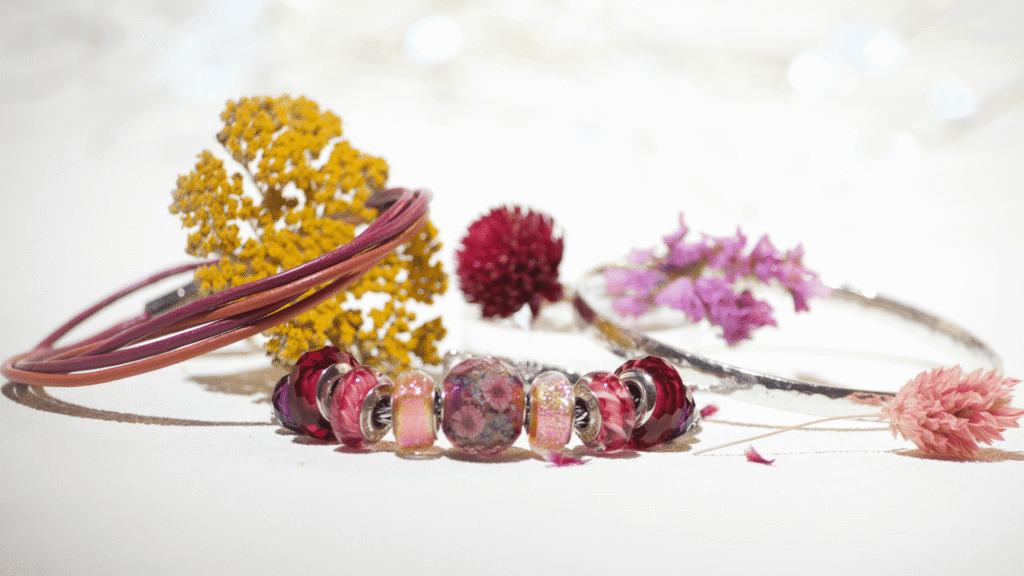
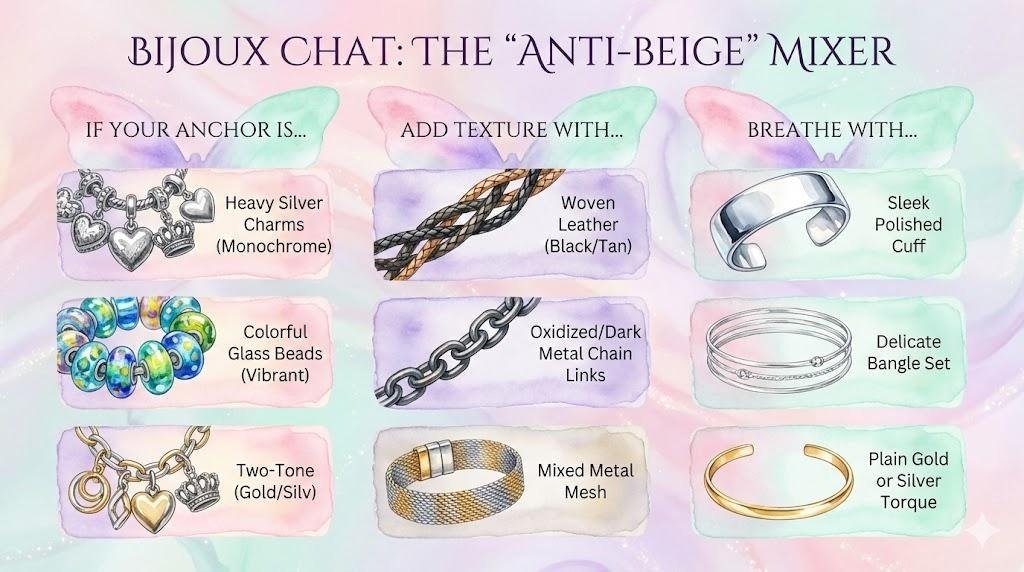
1. The Anchor (The Hero) This is usually your European charm bracelet. It holds the color, the weight, and the emotional significance. It’s the focal point that draws the eye first. It’s the lead singer.
2. The Texture (The Rhythm Section) If everything is shiny silver, the eye gets bored. You need disruption. This is where you introduce leather (worn, braided, or smooth), oxidized metal, or perhaps woven silk. This layer adds warmth and contrast against the cool metal of the anchor.
3. The Breather (The Negative Space) A stack needs room to breathe. A sleek, highly polished plain cuff, a simple torque bangle, or a delicate chain provides “visual silence” amid the noise of the charms. It separates the Anchor and the Texture so they don’t fight for attention.
The “Anti-Beige” Philosophy of Mixing
The biggest mistake people make is thinking everything has to “match.” Forget matching. Think about cohesion.
Does a rugged leather bracelet “go” with fine silver charms? Absolutely. That tension between rugged and refined is exactly what makes the stack interesting. It shows a confident eye.
To help you visualize this, we’ve created a guide inspired by the soft, sophisticated palette of our studio.
The Sound of Style
We cannot talk about anatomy without talking about the auditory experience. A good stack has a specific resonance. It’s not a clatter; it’s a composition.
The way your bracelets interact—the heavy thud of a full charm bracelet against the higher-pitched ring of a hollow bangle—creates your personal soundtrack for the day.
Conclusion: The Stack of One
Let’s end with an important note from the Art Director’s chair.
Sometimes, the boldest choice is restraint.
You don’t have to wear five bracelets to have a “stack.” A single, heavily curated European charm bracelet, where every bead is chosen with intention, is a stack in its own right. It is a stack of memories, a stack of choices, a stack of moments.
The “Anti-Beige” way isn’t about how much you wear; it’s about why you wear it.
It’s all about fun, color, and wearing your story on your sleeve—literally. So go ahead, make some noise.